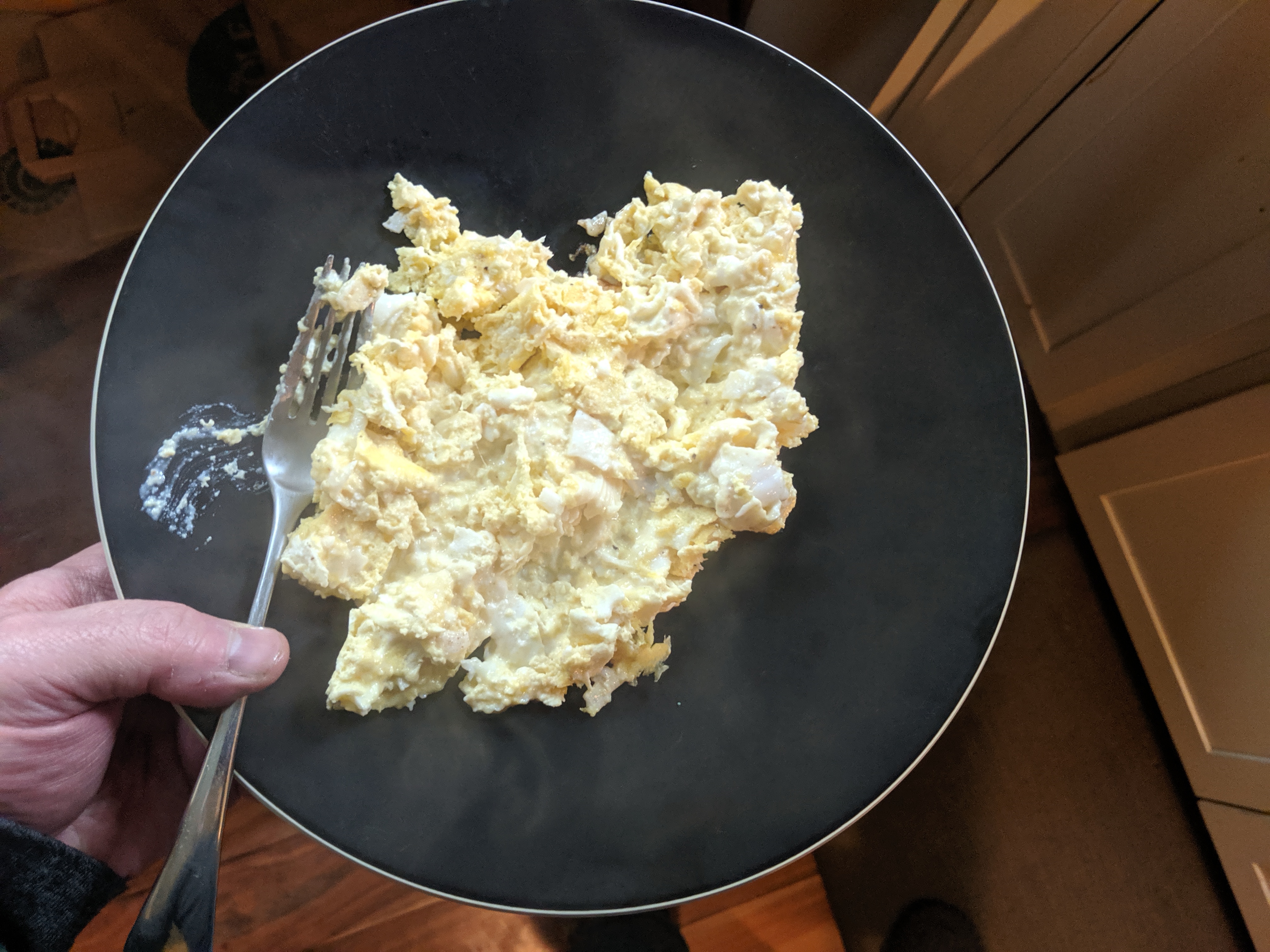
Really? I’m going to write an article about scrambled eggs? The thing most everyone who ever learned to cook anything learned to cook first?
Yep. I am.
Look, it’s essentially the first thing I learned how to cook also. I say “essentially” because the first thing I remember learning how to cook was a variation on scrambled eggs. It was salami and eggs, I learned it from my Grandpa George. But there was scrambling of eggs involved. And I now know that he taught me to make the scrambled eggs wrong (sorry Grandpa).
I made scrambled eggs the wrong way – okay not wrong, but the not-nearly-as-good way for ~47 years.
Then I came upon a brief video of Gordon Ramsey showing how to do it right. I don’t use his method, precisely. But I follow his principles and the eggs are way better. Where my scrambled eggs were always fluffy, these are creamy. And the flavor is much more pronounced.
Anecdotally, everyone that I’ve cooked these eggs for has acknowledged that they’re way better this way.
Mostly, doing this is about patience and having the right tools.
First off, you’re going to need a good non-stick pan. I like the 12″ Professional Restaurant Fry Pan from Tramontina (https://www.amazon.com/Tramontina-80114-536DS-NSF-Certified-Professional/dp/B009HBKQR0/ref=sr_1_3?crid=1I34HFR1OG5BK&keywords=tramontina+12%22+commercial+non-stick+restaurant+fry+pan&qid=1559261859&s=gateway&sprefix=Tramontin%2Caps%2C1158&sr=8-3). Best non-stick pan I’ve ever owned, and far and away one of the least expensive.
You do need to take care of it, but that’s not hard to do:
No more than medium heat.
No metal or wooden tools against the surface.
No scouring pads – use a soft rag and soap to clean it.
You also need a good spatula or turning tool. I really love rubber tipped wooden spatulas like the one in this photo:
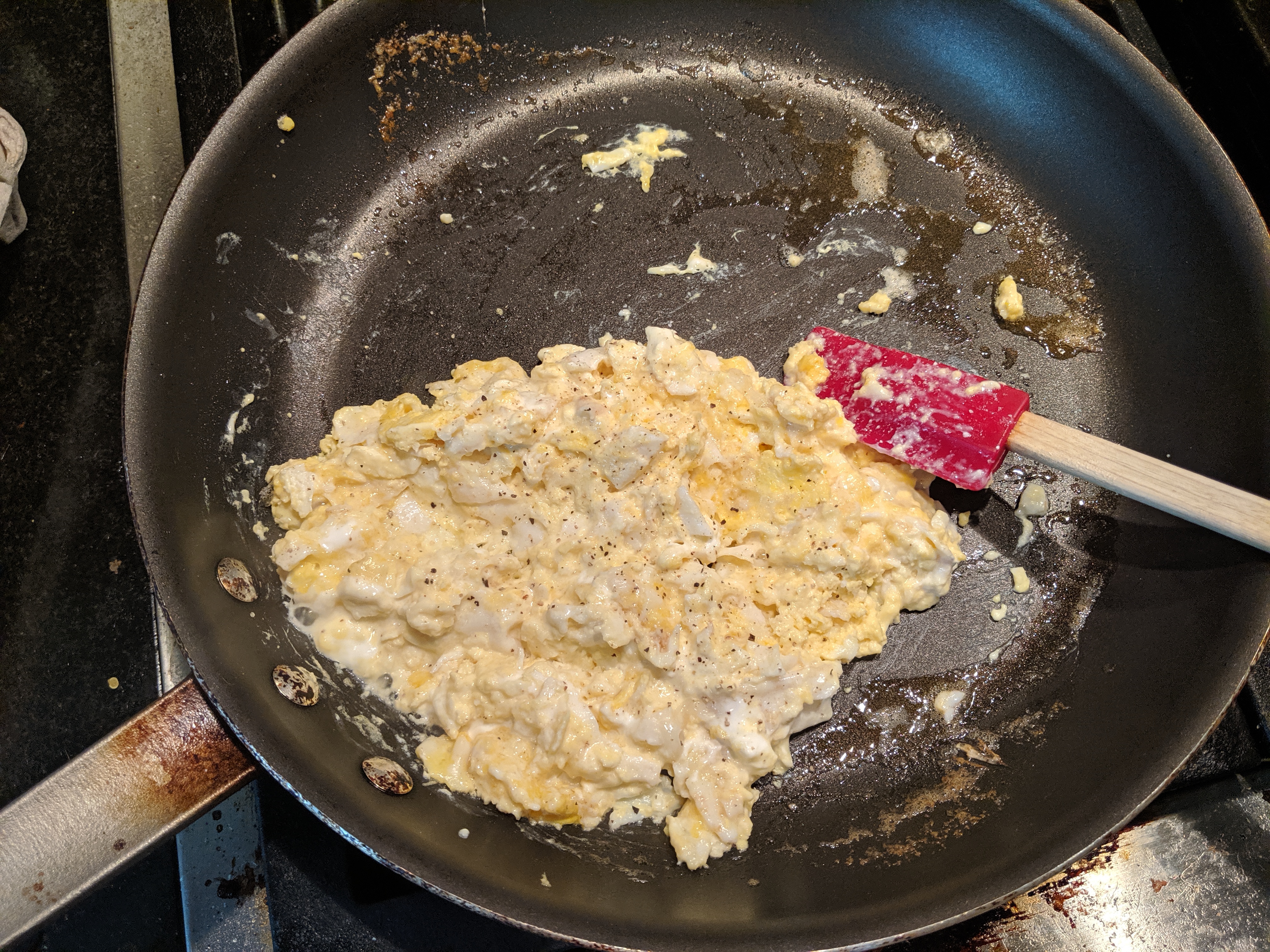
I have several of them. They’re terribly useful and inexpensive.
That’s it. Other than that, in order to do this, you’re going to need eggs, butter, some kosher salt and fresh pepper, and some dairy. Gordon recommends creme fraiche, but that’s hard to find. I use sour cream; but half and half, whipping cream, or whole milk will work also.
This isn’t going to be a recipe in the traditional sense. It’s more of a how-to. And what not to do that you’re likely already doing.
Ok? Here goes:
Don’t break your eggs into a bowl and beat them. Or add salt and pepper and dairy to them – yet (I’ll explain that further down).
Mostly, the key to this is to avoid over-working the eggs, and to tightly control your heat.
Instead…
Put your pan over low heat and drop a knob of butter into it. Watch it melt.
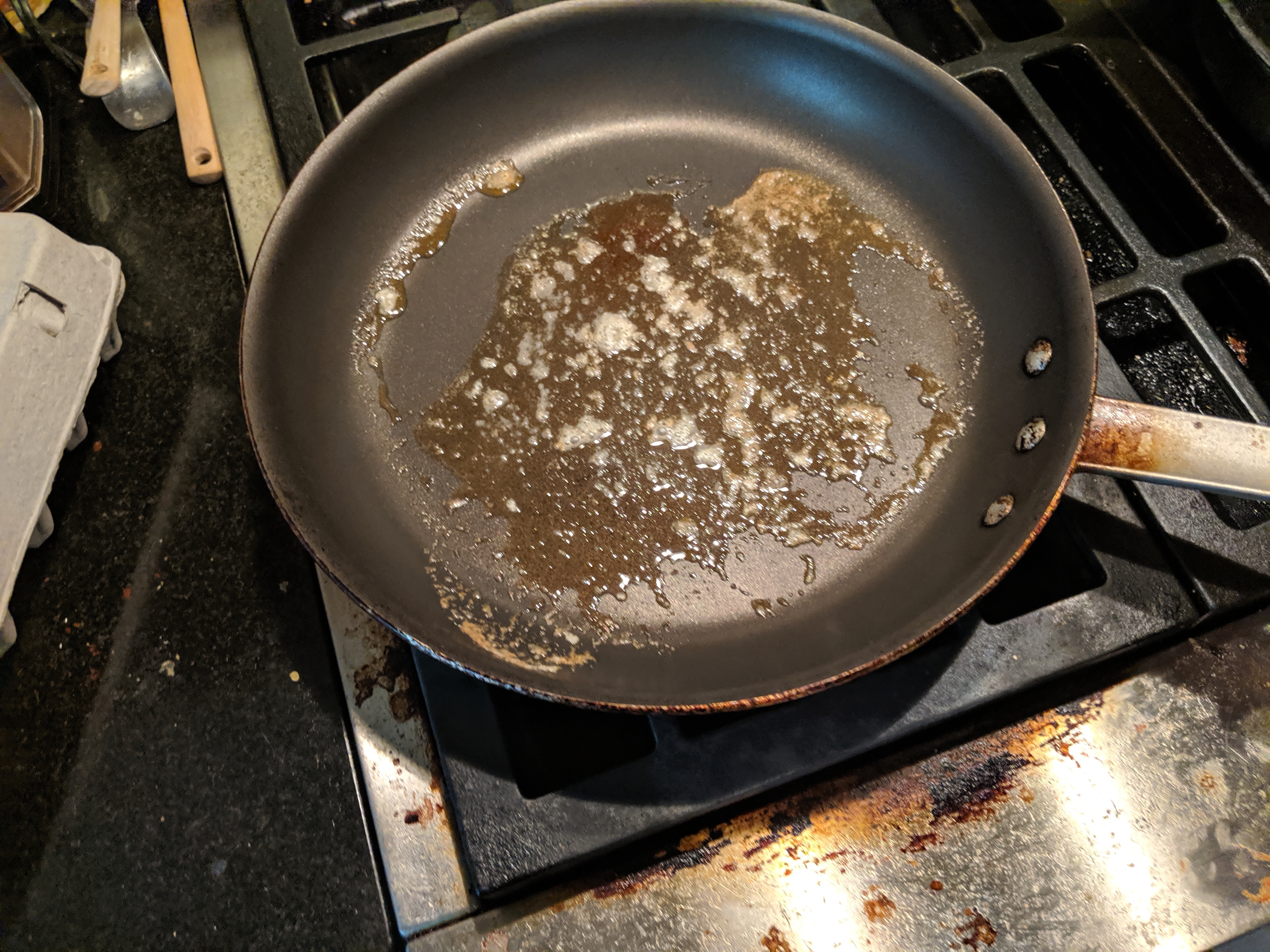
When it’s melted, break your eggs into the pan:
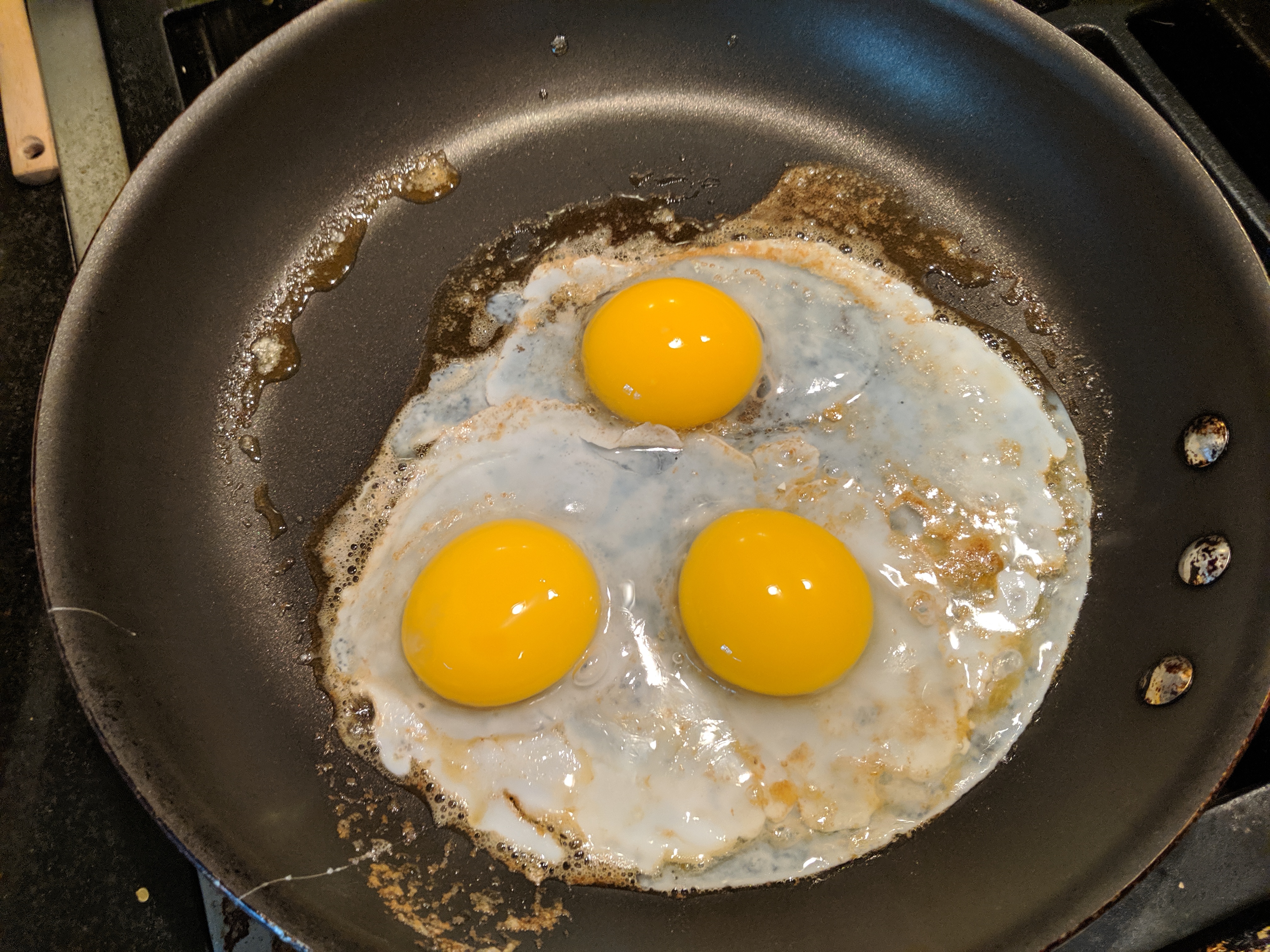
Aren’t those eggs beautiful? They’re duck eggs from one of our weekend farmer’s markets in Madison. I told Nico, my egg guy, I’d give him a shout out here, so here it is. Bryant Family Farms from Mineral Point Wisconsin. He doesn’t have a website on his business card, but he’s at the West Side Farmer’s Market in Madison on Saturday mornings. He also sells chicken eggs and chickens, ducks, and guinea fowl. I’ve cooked a lot of his product, it’s always excellent.
This method works just fine with chicken eggs, and they’re really good. But I prefer duck eggs when I can get them. They’re just much richer.
Remember – low heat. You don’t want them to cook on contact.
I have no more photos from here until the end, because this process doesn’t tolerate the time to take photos.
Immediately grab your spatula, lift the pan off the heat, and break the eggs up in the pan.
Put the pan back on the heat, but don’t go anywhere.
Watch carefully. The eggs will start to form curds. As soon as you see curds forming lift the pan off the heat and break them up.
As soon as they’re broken up stop stirring and put the pan back on the heat.
Repeat this until the moisture in the pan has thickened, but not fully evaporated. If curds are forming fast turn the heat down. If they’re not forming at all turn it up (but just a little bit).
You’re going to be doing this for seven to ten minutes, but it’s worth it.
Be patient.
When the liquid in the eggs has thickened, turn the heat down a bit, and add your dairy, salt, and pepper. Stir in your dairy until it’s fully incorporated.
You’re adding the salt at the end because salt dehydrates things. It makes your eggs tough. Adding it at the end means you get the flavor without impacting the creamy texture.
That’s it. Get them off the heat and onto plates.
Give this a try. I promise you’ll see scrambled eggs completely differently.
 Yet Another Food Blog
One Comment Add yours